The story of M - Engineering
A Great Design Has to Work in Practice
A Pod or Thruster cannot be engineered in isolation from the vessel it is designed for.
Power, operating profile, hull design, loads, installation space and serviceability all influence the final solution.
That is why Mechanical Engineering does not start with drawing. It starts with understanding what the vessel has to do in real operation.
Meet our M-Engineering Team
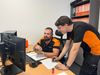
Semih and Ole form the M-Engineering Team at AAApropulsion.
Semih brings more than a decade of experience with our propulsion technology, while Ole connects engineering directly with the practical reality of assembly, installation and service.
Together, they keep every design focused on one question: does it work not only on screen, but also in the workshop, on board and throughout the vessel’s operational life?
Understanding the Vessel Comes First
No two vessels are the same.
A ferry operating the same route every day places different demands on its propulsion system than a workboat, inland vessel or naval vessel.
That is why we do not believe in simply selecting a standard Pod and adapting the vessel around it.
Good Mechanical Engineering starts with asking the right questions.
- What does the vessel need to achieve?
- Under which operating conditions?
- What loads and forces will act on the installation?
- How will the Pod or Thruster be integrated into the hull?
- How much installation space is available?
- How do we ensure that what we design can also be built, installed and maintained in practice?
Together with the Naval Architect, shipyard, System Integrator and our own E-Engineering Team, we bring those technical interfaces together as early as possible in the project.
A change to one part of the design can affect several others.
That is why engineering decisions must remain controlled and traceable.
Calculations, drawings, material selections and technical decisions are documented and updated throughout the project.
From the first design through Production and ultimately installation on board.
Because problems prevented during engineering do not have to be solved later during installation or Commissioning.
Engineering Meets Practice
A design can be technically correct and look perfect on screen.
But that does not automatically make it a good design.
That is why we continuously challenge each other on the practical side of engineering.
Ole regularly works in the production facility and sees first-hand what a design means once it has to be assembled.
- How will it be built?
- Can every part be reached properly?
- Is the chosen solution practical to install?
- What can we learn from Production and improve in the next design?
The same questions become even more important when a Pod or Thruster has to be installed on board.
In our own production facility, we can still control the working conditions.
On board, you have to work with the space that is actually available.
That is why we already consider the complete installation situation during engineering.
- How will the installation be brought on board?
- Is there enough space for installation?
- Are connections accessible?
- Can components later be inspected or replaced?
- Will a Service Engineer still be able to reach the parts that matter five or ten years from now?
These details may sound obvious.
But they often determine how well a design performs in real operation.
Experience from Production is therefore fed back into Engineering.
Just as experience from installation, Commissioning and Service is fed back into the next design.
That is how Engineering and practice keep each other sharp.
For us, a design is only truly successful when it is not only technically correct, but can also be built, installed and maintained in practice.
Designed for a Lifetime
A propulsion system has to do more than perform during FAT, HAT and SAT.
It has to remain reliable throughout thousands of operating hours.
That is why Mechanical Engineering looks beyond Production, installation and delivery.
Components must remain accessible for inspection and maintenance.
Loads must remain manageable.
Wear should be predictable wherever possible.
And when a component eventually requires maintenance, it must be practical to access and replace.
Serviceability is not something that starts after delivery.
Serviceability starts at the drawing board.
We carry that principle into every new design.
And whenever we learn from Production, Commissioning or Service that something can be made smarter, simpler or better, that knowledge is fed back into Engineering.
This creates a continuous improvement process.
Not because the previous design was wrong.
But because every project gives us new knowledge that can make the next design even better.
For our customers, good Mechanical Engineering ultimately means certainty.
Certainty that the solution fits the vessel and its operational profile.
That mechanical interfaces, loads and installation requirements have been considered from the beginning.
That what is shown on the drawing can actually be built and installed.
And that maintenance and service have been considered long before the vessel enters operation.
A good design is not the one that looks perfect on a screen.
A good design proves itself on board — every single day.
For us, Mechanical Engineering is therefore about more than calculations and drawings.
It is about understanding, thinking ahead and taking responsibility for what is ultimately built.
Because only when Engineering, Production and real-world experience come together do we create a solution a vessel can rely on for years to come.
Contact us
Have a mechanical engineering challenge? Let’s talk.
Whether you are developing a new vessel, integrating a Pod or Thruster into the hull or looking for a solution that considers installation, accessibility and serviceability from the start, our engineering team is ready to help.
Contact AAApropulsion to discuss your vessel, mechanical interfaces or installation requirements.